Speed in Music
Promotores: Prof. dr. R. J. Barrett · Prof. dr. M. Cobussen
Chapter 1: Introduction
1.1 Stories
Story #1
1998, Rotterdam, Netherlands
Gaudeamus Interpreters Award competition
As a 28-year-old flutist who had moved to the Netherlands four years earlier to specialize in new music, I saw this competition as the pinnacle of my aspirations, and the center of my artistic world. I had diligently prepared over sixty minutes of demanding 20th-century repertoire for this moment, including works by Salvatore Sciarrino, Theo Loevendie, and myself. Yet it was Brian Ferneyhough’s Carceri d’Invenzione IIb that consumed the lion’s share of my focus. Over more than a year, I dedicated daily hours to mastering its nine dense pages filled with microtones, irrational meters,1 and intricate 128th note quintuplet rhythms. After prolonged engagement with the score, I reached a point where performing it from memory seemed within grasp.
Unsurprisingly, the judges selected this formidable piece for me to perform in the first round. Pushing the music stand aside, I managed, despite significant nerves, to complete the piece without memory lapses. My joy at progressing to the second round, however, was brief - I did not advance further.
Determined to learn from the experience, I approached one of the judges, percussionist Steven Schick, for feedback. His critique was insightful: when performing Ferneyhough by memory, one must guard against unintentionally quantizing rhythms - reducing a nuanced narrative rich with multiple tempi and complex tuplets into just a few simplified speeds.
Schick’s comment sparked numerous questions for me. Chief among them was how to authentically render the diverse array of speeds indicated in the score. Had my method - merging bar-specific beat patterns with approximations of tuplet speeds - fallen short? Furthermore, some passages called for speeds beyond my technical abilities, turning precisely notated tempi into sections performed only “as fast as possible.” Had I inadvertently grouped too many segments into this simplified approach, thereby reducing rhythmic complexity? Additionally, I wondered if memorizing the piece, rather than reading directly from the score, contributed to this unintended rhythmic simplification. Certainly, performance anxiety had accelerated my playing and introduced considerable physical tension. This recognition raised another crucial question: what role does physical embodiment play in producing and controlling speed during performance?
These inquiries began to ferment, eventually igniting my exploration of speed in music and forming the core theme of this dissertation.
Story #2
1993, San Francisco, United States
Lesson with flutist Tim Day
I was playing a passage from a piece consisting of straight 16th notes, but there was one particularly challenging part with some tricky third-register fingering combinations that I consistently struggled with, often flubbing or missing notes entirely. Day’s suggestion was to slow down at that part, making sure I hit all the notes. After doing so, he pointed out the result: the passage sounded like even 16ths, smoothly played without any perceptible slowing down, yet correctly executed. This offered a clear demonstration that perceived speed is situated, shaped by attention, bodily control, and the felt pressure of technical difficulty.
1.2 Research Topic and Research Questions
Both these stories underscore the elusive and fluid nature of speed, demonstrating how its perception can differ significantly between performer and listener, and how easily the complexity and subtlety of speed can be unintentionally simplified. They highlight the body's significant yet often overlooked role in managing speed during performance, the different outcomes of playing from memory versus reading from a score, and the impact of emotions on our temporal perception. Collectively, they show that the perception of speed depends on many factors, including bodily technique, memory and notation, attention, and emotion. For that reason, musical speed is variable across situations and easily reduced to a single, oversimplified parameter.”
This realization contrasted sharply with my earlier rhythmic training, where rhythm was something concrete and predictable, neatly defined by notations, metronomes, or the steady reliability of a groove. My foundational experiences included:
- Earliest music lessons with flutist Gary Stotz, providing a strong rhythmic foundation through regular practice with the Tap Master2 rhythmic training machine. He also started teaching me to improvise, fostering a creative exploration of rhythm.
- Formal classical music studies combined with immersion in jazz and groove-based popular music.
- College studies at the Cleveland Institute of Music, involving dedicated practice and mastery of embodied Dalcroze Eurythmics exercises under the guidance of David Brown, enhancing my physical understanding of rhythm and musical timing.
- Studies in the Netherlands, initiating an exploration of rhythmic techniques from Indian Carnatic Classical music, which eventually led to the development of my Advanced Rhythm and Pulse course at the Utrecht Conservatory.
Schick’s and Day’s feedback stayed with me. Reflecting on these experiences, I came to see musical time as a rich and intricate web, encompassing a multitude of topics such as notation, accurate learning, integration in performance, rhythmic complexity, subjective interpretations, differences in tempo perception between performers and listeners, and a wide array of expressive nuances. In the years following the competition mentioned above, I expanded my musical activities to focus principally on composition, actively engaging with the diverse aspects of rhythm and time. Looking back over several decades of compositions and musical experiences, I recognized that all these varied rhythmic explorations were connected by a concern that emerged as a recurring dimension: speed. Ultimately, my artistic journey has consistently revolved around understanding and expressing the rich and varied ways in which speed can manifest and operate in music, leading to the central inquiry driving this dissertation: What is speed in music, and how can I explore it creatively and practically within my artistic practice?
In posing this two-part question, it is important to note that speed will not be treated here as a synonym for related terms such as tempo, rhythm, or time. While those concepts will be addressed and often overlap with speed, they name different dimensions of musical temporality. Tempo refers to a regulated pulse; rhythm to the patterned organization of durations; and time to a much broader field of musical and experiential temporality. Speed, as I develop it in this dissertation, refers more specifically to the perceived and enacted rate of musical events. Rather than a single parameter, it is an emergent composite of several simultaneous rates, including pulse, event density, grouping, and rates of musical change. In this sense, perceived speed functions as an experiential resultant of that multiplicity, and it can diverge from tempo markings, rhythmic grids.
In the next section I will present some examples of speed in my music.
1.3 Speed in My Music
Here are some brief examples from my works that employ different techniques and produce diverse expressive results, expressing how I imagine the possibilities of speed in music. Unless indicated otherwise, the compositions discussed in this dissertation are my own, and any instances of co composition are explicitly noted. Each example highlights a distinct approach to speed, among many approaches which will be further examined in this thesis.
1.3.1 Shifts in Speed
Section “Gear Box”, movement 4 “n’est-ce pas spatial?” from six pièces mécaniques (2012) for reed quintet and trumpet
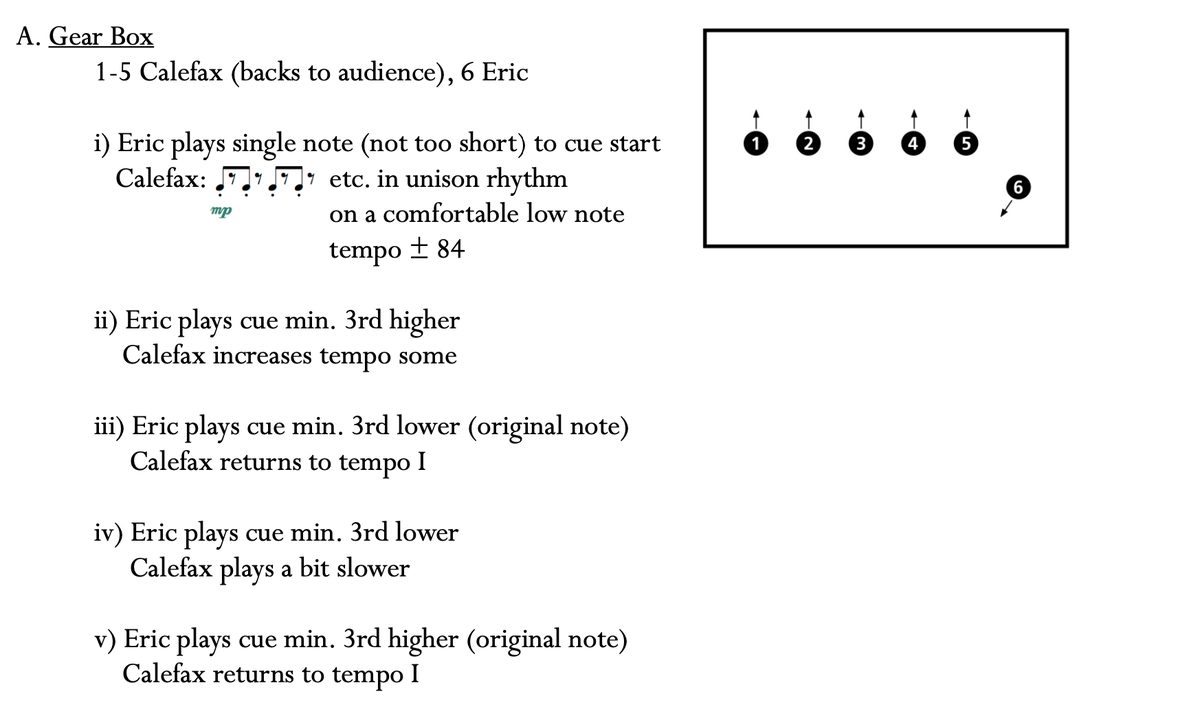
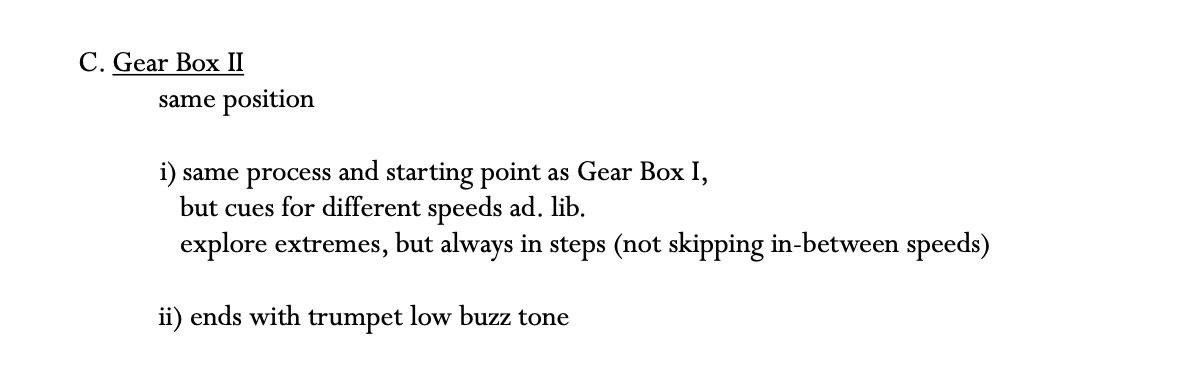
Example 1.1 “Gear Box”, score excerpt. Video excerpt.3
In Gear Box I explored changes of speed in repeated notes, using a simple cueing system in which the trumpeter accelerates and decelerates to produce distinct characters at different rates. The part explicitly invites an exploration of the extremes of both slow and fast tempos. While the mechanism is simple, the results can be surprising. At slower tempi, the increased spacing between notes heightens the sense of anticipation before each onset. As the speeds become faster and faster, at 3 minutes and 1 second into the performance, the reed players transition from performing clearly articulated individual notes to employing a flutter tongue technique, producing a rapid, buzzing effect that significantly alters the texture and perceived speed of the music.
1.3.2 Slow Speed
Moonrise, for solo flute (1998)
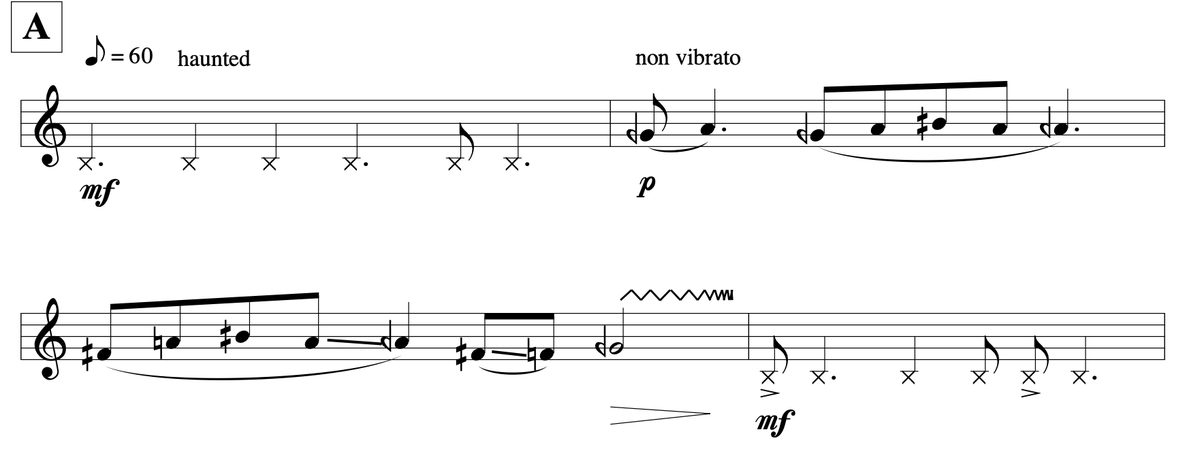
Example 1.2. Moonrise, score excerpt. Audio excerpt.
A slow 8th note tempo allows for precise microtones to be clearly perceived. Because key clicks are brief transients and the notated durations are long, a clear contrast arises between each short click and the silence that follows before the next one, emphasizing the intricate relationship between note length, silence, and the articulated flow of time.
1.3.3 Fast Speed
Cycle Games 1, for vocal percussion (2019)
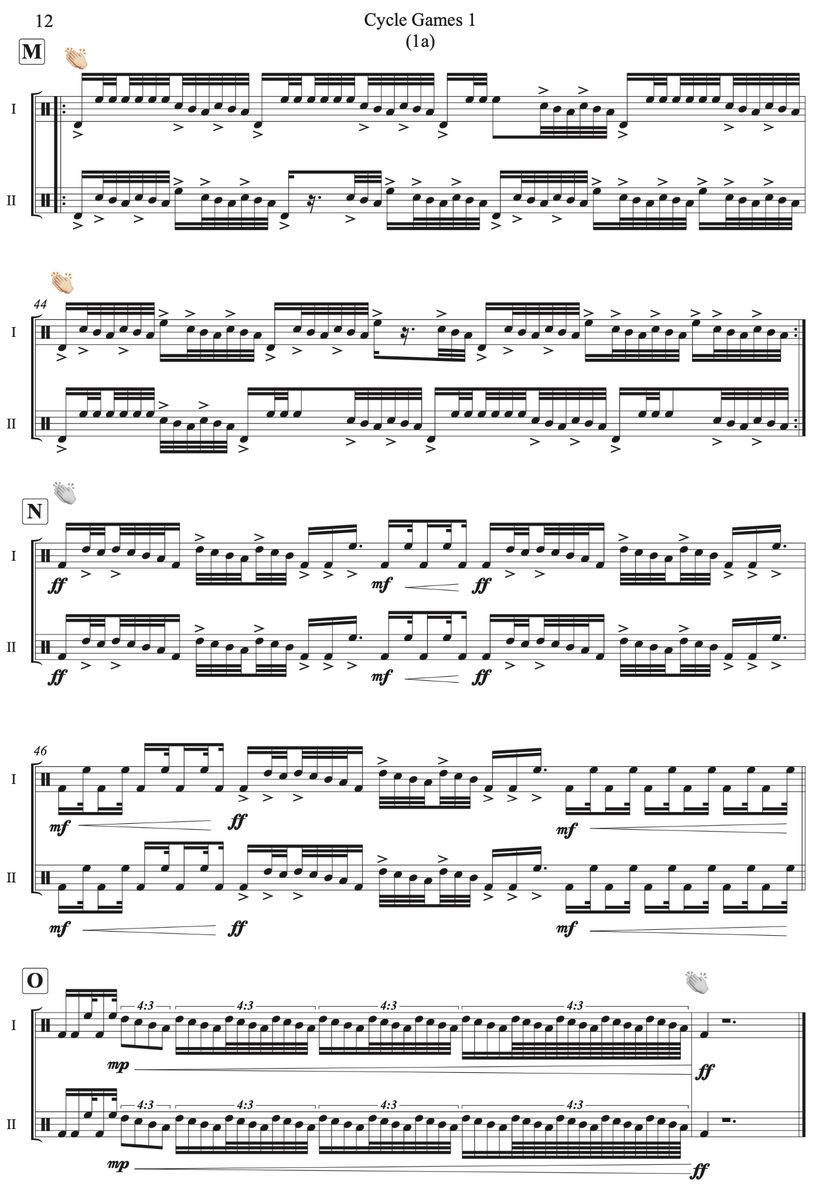
Example 1.3. Cycle Games 1, score excerpt. Audio excerpt.
This example demonstrates vocal percussion woven into rapid rhythmic patterns, drawing on the narrative qualities typical in Indian percussion music that influenced this piece. The different vertical placements on the staff indicate motivic groupings rather than specific pitches or instruments. Both layered voices and unison approaches are explored. The rhythmic patterns and groupings change, while the tuplet remains consistent.
1.3.4 Changing Tempo
Garden of Iniquitous Creatures, for mixed sextet (2016)
Through metric modulation, a single motive is abruptly shifted into different speeds, creating instability and a deliberate sense of imbalance.
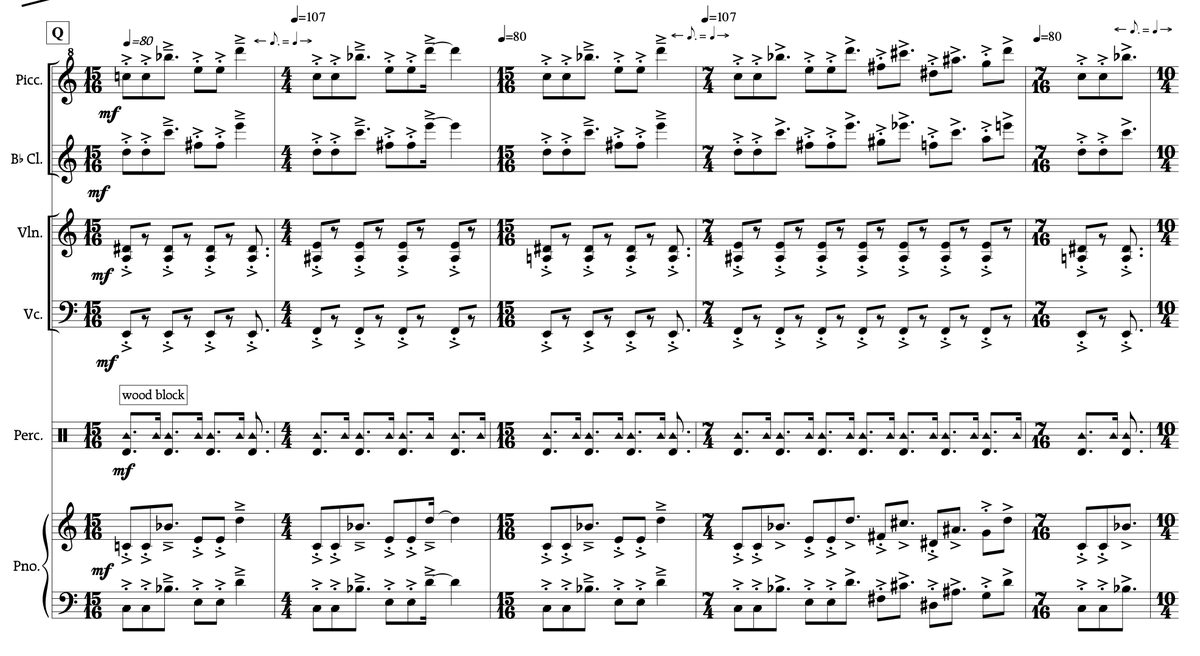
Example 1.4. Garden of Iniquitous Creatures, score excerpt. Audio excerpt.
1.3.5 Rhythms and Theme of Different Speeds
Benson Town, for contrabass flute and mridangam (McGowan & Manjunath, 2016)
In Benson Town, composed in collaboration with percussionist B.C. Manjunath, the opening theme is comprised of four-note motives in rhythmic lengths of a 16th, an 8th, and a dotted 8th, separated by a single 8th note. For the second iteration, these note lengths are systematically halved, reflecting the mathematical precision characteristic of Carnatic rhythmic structures. This proportional manipulation, juxtaposing precise elongation with a doubling of speed, generates anticipation, surprise, and structural clarity.

Example 1.5. Benson Town: score excerpt. Audio excerpt.
1.3.6 Use of Tuplets
Cycle Games 1, for vocal percussion (2019)
Both simple and nested tuplets create an intricate rhythmic dialogue, evoking simultaneous, overlapping conversations and creating layered speeds, where different lines move at different rates at the same time.
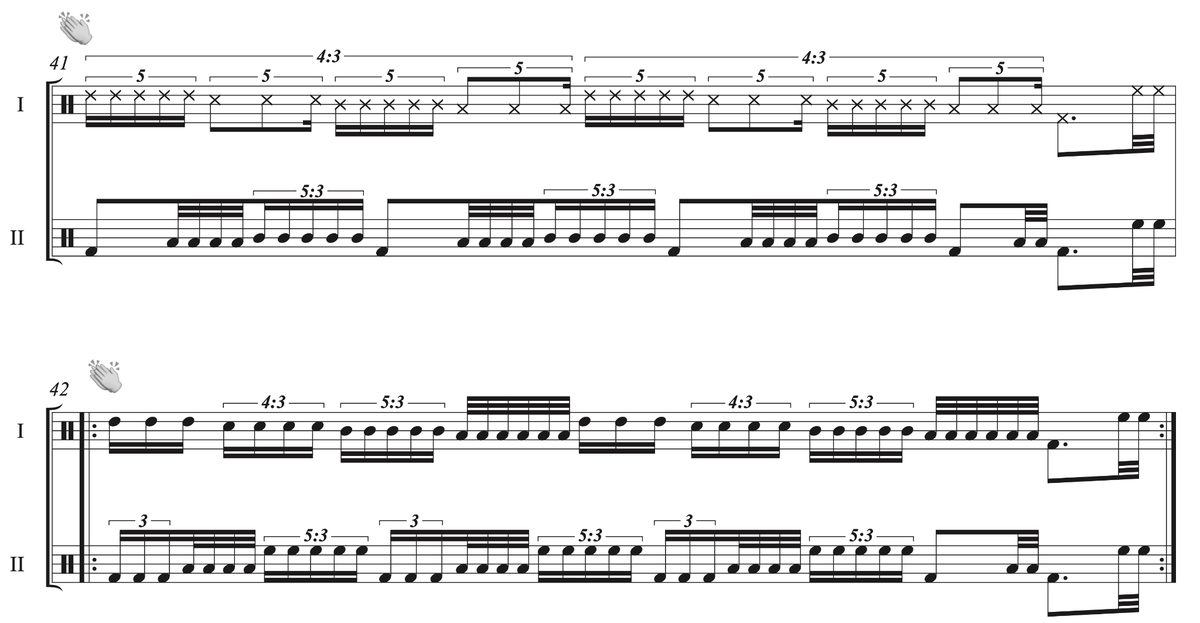
Example 1.6. Cycle Games 1: score excerpt. Audio excerpt.
1.3.7 Polytempo
Sydney Polypulse, for mixed sextet (2019)
Each instrumentalist follows an individual tempo, creating textures of subtly transforming rhythmic relationships through simple repeated notes.
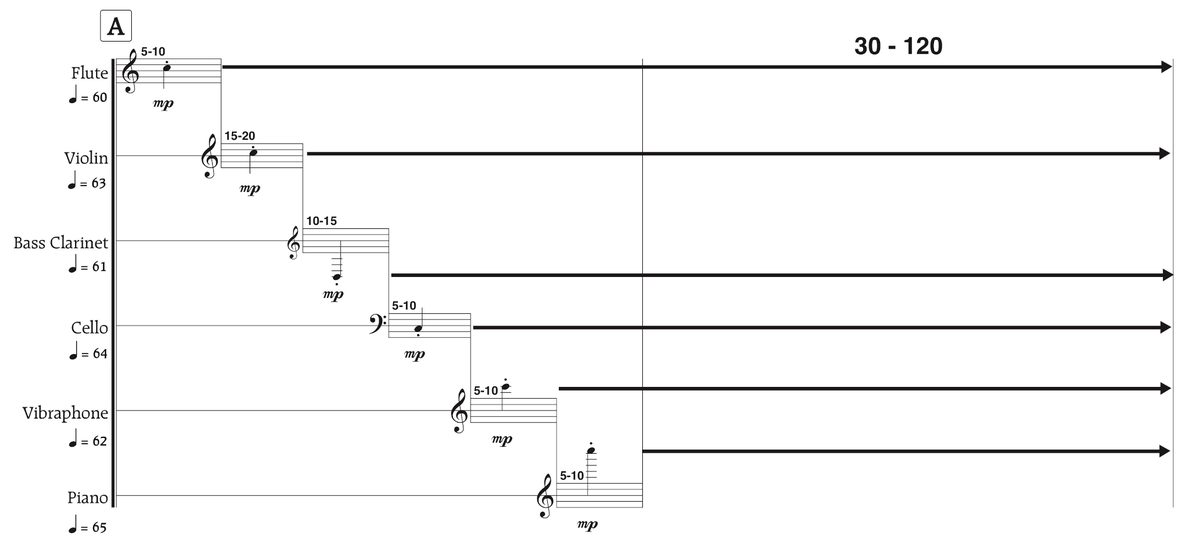
Example 1.7. Sydney Polypulse: score excerpt. Audio excerpt.
1.3.8 Layered Speeds
Tools, for mixed quartet (2003), movement “Telescopic Ladder”
A temporal canon features four voices, each progressing at a 4:3 speed ratio to the previous voice, creating the impression of time compressing as the ensemble approaches unison.
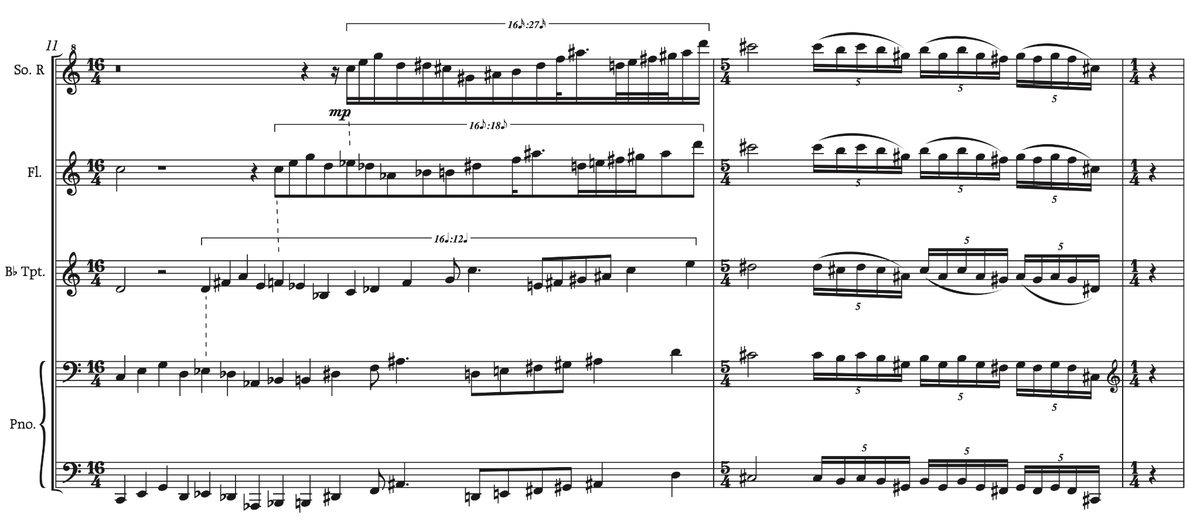
Example 1.8. movement “Telescopic Ladder”, score excerpt. Audio excerpt.
1.3.9 Industrial Speeds
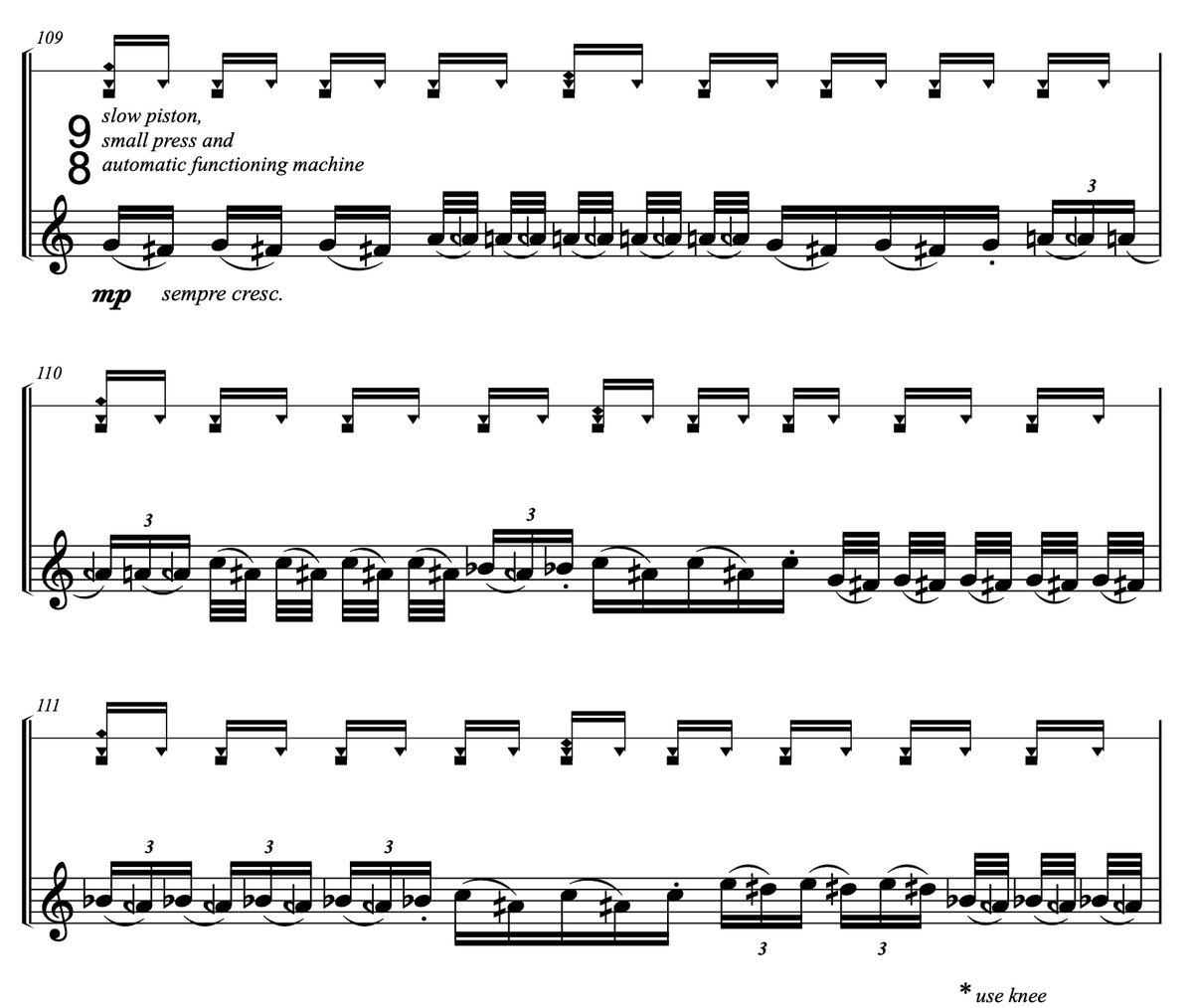
Workshop, for recorder and fixed media (2004)
The rhythms in the recorder part mimic machine-like regularity, executed as exactly as possible with minimal expressive microtiming. The more rigidly the onsets lock to an even grid, the more the music projects a single, machine-like speed, with the intended result of a steady, uniform sense of speed with no perceptible timing deviations.
Example 1.9. Workshop: score excerpt. Audio excerpt.
1.3.10 Electronic Speeds
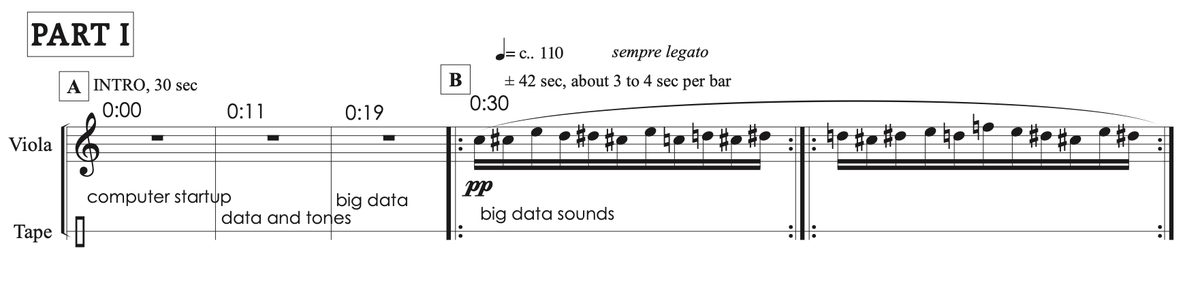
Volt, for viola and fixed media (2015)
The tape part contrasts the rapid speeds of computer-generated sounds with slower human movements, reaching magnitudes even faster than the industrial machines in the example above.
Example 1.10. Volt: score excerpt. Audio excerpt.
1.3.11 No Speed
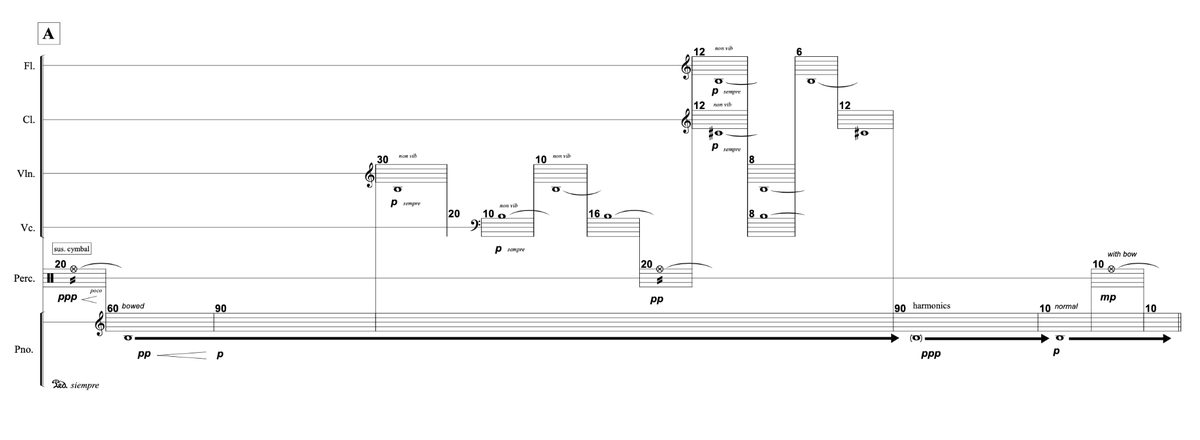
Sound Becomes Visible in the Form of Radiance, for mixed sextet (2010)
Durations are explicitly defined in seconds (above the staff at the left side of each bar), emphasizing subtle timbral shifts at glacially slow pacing. The first bowed note in the piano of two and a half minutes contains almost no development of sound save a slight crescendo. The intention from the outset was to “stop time” for the listener and remove any expectation for rapid events.
Example 1.11. Sound Becomes Visible in the Form of Radiance: score excerpt. Audio excerpt.
Collectively, these examples reveal speed in music as multifaceted and nuanced, shaped profoundly by compositional techniques, interpretative choices, and diverse artistic intentions. In this dissertation, the term speed functions as a deliberate conceptual shorthand, drawing attention to this complex web of concepts and perceptions. Each piece demonstrates speed as integral to musical expression, beyond simple tempo measurements, engaging deeply with rhythmic, temporal, and perceptual dimensions.
1.4 Why Speed?
In order to understand the context and significance of speed in music, it is necessary to briefly zoom out to examine the broader topic of musical time. In this dissertation, I treat 'musical time' as an umbrella word that encompasses a complex web of subtopics, each carrying different meanings depending on their context. Duration, tempo, rhythm, timing, and speed can all be seen as different dimensions of this overarching term.
Time in Music
In practice, the word “time” has many meanings. For example, here are some uses specifically related to music:
- The “total time” of a piece is its duration.
- A “time signature” gives the length of a bar in beats.
- “Timing” usually refers to the exact placement of notes in performance, but could also refer to flow of the phrasing or proportional choices in the form.
- “Double time” means to play twice as fast.
- “Repeat that passage 4 times” means to play four iterations of it.
- “Time stretching or compression” in digital audio processing is to take a given duration of recorded audio and change it, resulting in its perceived speed also changing.
- “Real-time” processing means to apply effects or changes to a sound as it is being played.
- “Music of the time” refers to the musical style of a specific chronological period.
Across music theory, musicology, and performance studies, time has emerged as a central topic of inquiry, particularly from the mid-twentieth century onwards. In recent decades, scholars have increasingly treated musical time not just as a backdrop for events, but as a crucial dimension of musical experience and structure. For example, prominent music theorist Jonathan Kramer opened his book The Time of Music from 1988 by observing that musical time had not been widely recognized as an independent field of study (Kramer, 1988, p. 2). Just thirteen years later, composer and computer music researcher Curtis Roads proposed a detailed parsing of musical time in his book Microsound (Roads, 2001, p. 5), including a figure presenting "Time Scales in Music."
Understanding time in music involves exploring multiple perspectives across various academic disciplines. What follows is a concise, though not exhaustive overview of the ways in which various disciplines generate different understandings of musical time, including speed, duration, rhythm, and synchronization.
- Music Theory: Focuses on rhythmic structures, meter, tempo, and timing relationships within compositions.
- Performance Studies: Investigates how performers interpret and embody time, including microtiming, expressive timing, and synchronization.
- Cognitive Psychology: Explores perception of musical time, rhythm processing, memory, and temporal expectancy.
- Neuroscience: Examines neural mechanisms underlying rhythmic perception, temporal processing, and synchronization in the brain.
- Ethnomusicology: Considers cultural differences in (experiencing) musical temporality, including rhythm concepts, timing practices, and temporal frameworks in diverse musical traditions.
- Philosophy: Addresses conceptual and existential questions about musical temporality, time consciousness, and phenomenological experiences of musical duration.
- Physics and Acoustics: Analyses physical properties of sound, time-frequency relationships, duration, and temporal resolution.
- Composition: Studies compositional techniques that manipulate temporal perception, including speed, density, polyrhythms, and time dilation or compression.
- Computer Music and Technology: Explores digital representations and manipulations of musical time, including algorithmic composition, temporal modeling, granular level manipulation, and interactive systems.
- Sociology and Anthropology: Investigates how social contexts, rituals, and collective practices shape experiences of musical time and rhythmic coordination.
- Historical Musicology: Examines how concepts of musical time and rhythm have evolved historically, including changes in notation, temporal aesthetics, and performance practice.
- Ecological and Embodied Cognition: Looks at how the interaction between body, environment, and musical structures shapes temporal experience.
Time in music is fundamentally multidimensional, understood through diverse yet interconnected fields of study, and this overview provides a context from which to examine one particular aspect of musical temporality - speed.
Speed as an Underexamined Facet of Musical Time
Within the extensive literature on musical time, speed stands out as a fundamental dimension. Every piece of music embodies an approach to speed, implicitly or explicitly conveying something about its pacing, and listeners instinctively perceive passages along a spectrum of descriptors such as “fast,” “slow,” “rushed,” “relaxed,” “glacial” or “frenetic.” Although central to musical experience, speed has rarely been the primary focus of musicological inquiry. It is typically treated as a given parameter, such as tempo, rather than investigated as an integrated concept that combines compositional, performative, and theoretical perspectives. In what follows, I trace how speed is folded into neighboring discussions across music theory, performance research, and cognitive and scientific studies, before positioning my own practice based definition and framework.
A substantial body of work theorizes musical time without making speed a central, integrated concept. In the domain of meter and tempo, music theorist Justin London’s Hearing in Time (2012) offers a foundational psychological account that foregrounds perceptual and cognitive constraints on metric entrainment rather than speed as such. From an embodied and phenomenological perspective, music theorist Mariusz Kozak’s Enacting Musical Time (2020) describes musical time as enacted through bodily movement and interaction, again without isolating speed as a concept that cuts across composition, performance, and analysis. A broader disciplinary panorama appears in The Oxford Handbook of Time in Music (Doffman et al., 2021). Across its historical, analytical, cognitive, and ethnographic perspectives, questions that bear directly on speed are distributed across adjacent topics such as tempo and timing as embodied and cross-modal phenomena, rhythmic entrainment and beatmatching, musical timescales, and technological mediation such as the metronome and rhythmic quantization. The Handbook also approaches speed as a cultural condition, for example in discussions of musical time in a fast world or genres such as drum and bass, where rates of change and temporal density become aesthetic and social markers. At the level of large scale temporal categories, Kramer’s The Time of Music complements these accounts by offering an influential typology of musical temporalities and listening strategies, including linearity, nonlinearity, and multiple timescales, but it too leaves speed largely implicit within broader temporal categories.
Beyond music theory and time typologies, speed also remains largely implicit in research on musical expectation, auditory timing mechanisms, and flow. Much work in these areas concentrates either on structural parameters such as tempo, rhythmic patterning, and metric organization, or on experiential dimensions such as absorption, memory, and anticipation. On the structural side, London’s account foregrounds tempo, beat hierarchies, and entrainment, while music psychologist David Huron’s Sweet Anticipation (2006) models temporal expectation and prediction across multiple timescales, treating tempo primarily as a cue for expectation and emotional response. Cognitive neuroscientific work by Vani Rajendran, Sundeep Teki, and Jan W. H. Schnupp (2018) examines temporal processing in audition, including limits of temporal resolution, interval discrimination, and rhythm perception, focusing on timing mechanisms rather than on musical speed as an explicit category. At the experiential end, psychologist Andrea Chirico and colleagues (2015) review the literature on musical flow, surveying how states of absorption in performance, composition, and listening relate to temporal awareness. Together, these studies help specify cues and capacities that condition experienced speed, even when speed itself is not their organizing concept.
Speed is discussed indirectly in performance practice research and in laboratory based timing studies within music psychology, where tempo and timing are examined as resources and constraints in performance. Performance practice research has long explored tempo and timing as expressive resources. Performance scholar John Rink’s edited volume The Practice of Performance (2015) brings together case studies of performance decision making, including discussions of tempo flexibility, rubato, and timing nuance, but its focus remains on interpretive practice within specific works rather than on speed as a cross cutting category that links compositional design, bodily effort, and listener perception. Within music psychology, music psychologist Bruno Repp’s studies offer detailed experimental analyses of expressive timing and synchronisation. His article “A Constraint on the Expressive Timing of a Melodic Gesture” (1992) investigates how pianists shape timing within a specific phrase and how listeners evaluate such patterns. His later review “Sensorimotor Synchronization: A Review of the Tapping Literature” (2005) synthesizes empirical work on finger tapping to metronomes, probing accuracy, variability, and adaptation across tempi. These studies address tempo and timing with great precision, but they tend to treat tempo as an experimental variable rather than developing speed as a broader compositional, performative, and perceptual category. At the same time, they raise questions about how tempo and timing interact with affect and bodily load, which the next strand of research addresses more directly.
Scientific studies underscore the complexity of speed by examining timing accuracy and rhythmic synchronization across different tempi. Research on sensorimotor synchronization asks how accurately and flexibly performers can coordinate movements with external rhythms, and it reveals nonlinearities and tempo-dependent constraints that complicate any simple notion of “fast” or “slow.” Repp’s reviews on tapping and synchronization survey this literature, including findings on rate limits, error correction, and interpersonal coordination in ensemble contexts (Repp, 2005; Repp & Su, 2013).
A related strand links tempo to physiology and affect. Clinical researcher Ángel Fernández-Sotos and colleagues show how tempo and rhythmic units modulate listeners’ emotional regulation, demonstrating that different combinations can be used to shift mood and arousal (Fernández-Sotos et al., 2016). Physiology researcher Archana E. Thakare and co-authors find that faster musical tempi can enhance physical exercises and influence heart rates in young adults, indicating that perceived speed interacts with motor effort and physiological load (Thakare et al., 2017). Researcher Yanhui Liu and colleagues demonstrate that tempo systematically shapes the emotional experiences of both musicians and non-musicians, with faster tempi associated with higher arousal and distinct affective profiles (Liu et al., 2018). Taken together, these findings support two points at once: tempo reliably correlates with physiological and affective responses, yet the lived experience of musical speed is not a one-to-one function of tempo alone. It is co-determined by rhythmic configuration, articulation, timbre, effort, and listening context, which is why the same nominal tempo can feel more or less fast, light, tense, or demanding.
London develops this line of thought in “What Is Musical Tempo?” (2023), arguing that musical tempo is not equivalent to beats per minute and that it should not be treated as a simple synonym for speed. Instead, he describes tempo as a summary judgement, a perceptual distillation of multiple cues that include beat hierarchies, rhythmic density, articulation, timbre, dynamic profile, visual gesture, and an embodied resonance with human motor rhythms such as walking (London, 2023). This expanded use of tempo overlaps substantially with what I call musical speed. The difference is not the cue set but the analytic orientation. London is primarily concerned with how listeners arrive at an integrated judgement of faster or slower from many inputs. My framework uses the same constellation to describe how pace is constructed in practice, through compositional design, performative technique, and notational decisions, and how these layers remain partially independent in performance and analysis. For that reason, I use tempo to refer to the inferred beat rate and metrical level that underpin entrainment and coordination, and I use musical speed to name the wider field of interacting layers through which pace is composed, enacted, and perceived.
Many of these cues coincide with the parameters that I foreground in this dissertation. The overlap is not accidental, since both London’s account and my own treat musical time as something that emerges from the interaction of sounding events, bodily engagement, and culturally shaped habits of listening. The crucial difference lies in how the cues are framed. For London, they feed into a listener-oriented judgement that assigns a tempo to a piece or passage. In my account, the same cues belong to an ensemble of interacting layers through which speed is composed, enacted, and perceived, with tempo forming only one layer among others. Speed, as I will use and develop the term here, includes compositional design, performative techniques, and notational practice, as well as event density, layered temporality across parts and parameters, coordination, embodied effort and attention, and the cultural situatedness of listening and notation. Coming from practice-based research, it also addresses how speed is actively implemented in composing, improvising, and performing. Speed is therefore both perceptual and operational: it is a compositional strategy, a performative challenge, and a historically variable construct.
Building on these insights, this dissertation introduces a practice-based, artistic framework of musical speed that connects compositional design to performed enactment and to a listener’s sense of pace. Drawing on Chapter 2 concepts such as perceptual thresholds, density, smooth and striated time, rhythmic embodiment, notational strategies, and situated musical knowledge, the framework treats tempo as one cue within a larger constellation that produces experienced speed. In the next chapter and the examples that follow, I use this framework to analyze specific passages from my own works and from selected works by other composers, showing how changes in density, temporal layering, notation, and coordination create layered speeds that are heard and felt in performance.
Artistic Research
To work towards a grounded answer to the question What is speed in music, and how can I explore it creatively and practically within my artistic practice? I carried out artistic research, an approach that foregrounds situated and embodied knowledge and treats musical practice as a site of inquiry. This orientation is important for a study of speed because what counts as fast, slow, stable, or unstable often emerges in doing: in bodily effort, coordination with others, rehearsal decisions, and the feedback loop between notation and performance.
Music theorist and philosopher Henk Borgdorff highlights the value of practitioner knowledge that is specific to artistic situations as follows:
In the history of epistemology, the distinction is made between knowing that something is the case – theoretical knowledge, propositional knowledge, explicit knowledge, focal knowledge – and knowing how to do something, to make something – practical knowledge, embodied knowledge, implicit knowledge, tacit knowledge. (Borgdorff, 2012, p. 121, italics mine)
While this dissertation draws on both forms, it takes “knowing how” as its primary vantage point, using practical, embodied, and tacit forms of knowledge to ground and orient its theoretical claims about speed in music.
By explicitly presenting myself as both composer and performer within this research, I adopt a practice-based methodology anchored in concrete musical materials such as scores, recordings, instruments, and performance situations, and in specific procedures of making, rehearsing, and documenting. I analyze selected compositions through close work with scores, rehearsal and performance recordings, and reflective documentation of compositional decisions and performance experiments. This approach allows me to track how adjustments in tempo, density, articulation, gesture, and coordination change what performers can do and what listeners hear as pace.
Situated in an interdisciplinary space, this dissertation places these practice-based findings in dialogue with musicology, music theory, philosophy, and performance studies. The aim is not to claim a total account of musical time, but to develop a focused vocabulary and set of analytic tools for speed that can be applied across different musical repertoires and situations, for example across notated composition and improvisation, solo and ensemble performance, and studio and concert settings. Ultimately, by foregrounding speed as its central subject, this research offers a practice-based contribution to the study of musical temporality, with concrete ways to relate compositional technique, performed enactment, and experienced pace.
1.5 Outline
The two parts of my research question are addressed sequentially. Chapter 2 examines the first part, What is speed in music? Chapters 3, 4 and 5 address the second part, How can I utilize speed creatively and practically within my artistic practice?
In Chapter 2, I develop a working definition of speed in music as the rate of perceptual events in time, operating across multiple concurrent timescales and co-constructed by music, performer, environment, and listener. I build this account through five interlocking strands: thresholds of speed (exploring how temporal compression and expansion transform musical identity, from rhythm into pitch and texture), temporal resolution (biological limits of perception across species and their implications for human musical hearing), density and motion (showing how event density, gesture, and embodiment jointly shape perceived speed), smooth and striated time (elaborating and extending the work of Pierre Boulez, Gilles Deleuze/Félix Guattari, Gerard Grisey, and Brian Hulse, to propose a continuum rather than a binary), and finally the LEMI model proposed by Michelle Phillips and situated knowledge according to Donna Haraway, which allowed me to frame speed as an emergent, relational phenomenon. Throughout, I treat my own compositions and experiments as methodological tools, using them to probe perceptual thresholds, micro–meso–macro couplings and the interaction between notated grids, improvisatory agency, and performance context. Together, these perspectives prepare the conceptual ground for the more focused case studies in the later chapters.
In Chapter 3, I turn to tuplets as a central mechanism for shaping musical speed within subdivided time, and propose an expanded definition in which tuplets include both so-called irregular subdivisions and the metric subdivisions implied by the time signature. I trace their historical and conceptual origins, then develop a taxonomy of tuplet identities based on parity (even or odd), harmonicity, grouping strategies, and the rhythms articulated inside a subdivision grid, showing how each configuration produces a distinct felt character rather than a mere change in note count. Building on this, I introduce ratio tuplets, distinguish between "striation" tuplets (local grids) and "frame" tuplets (proportional tempo layers), and outline practical tools for performers such as stratification, frame reductions, and a system for quantifying speed changes between tuplets in percentages that can be read as tempo maps. In this chapter I also examine nested tuplets and complex polyrhythmic textures, arguing that such writing destabilizes the traditional 2:1 durational hierarchy and greatly expands the palette of temporal nuance available to composers and performers. Finally, by bringing the LEMI model and Haraway’s notion of situated knowledge to bear on the performer–listener divide, I argue that tuplets are not abstract ratios but situated affordances whose identity and difficulty are co-constituted by bodies, instruments, notations, and environments. This lays the groundwork for later chapters, where the tools for regulating speed are connected to broader questions of polytempo, improvisation, and creative agency.
In Chapter 4, I extend the investigation of musical speed into polytempo, treating it as a site for examining how multiple concurrent temporalities are constructed and negotiated in performance. I begin by theorizing the rhythmic grid as a hierarchical structure of tuplets, beats, and bars, and systematically permute three basic parameters - pulse, tuplet and meter - into twelve possible configurations, of which six constitute genuine polytempo; this typology allows me to situate historical examples (Charles Ives, Carl Nielsen, Elliot Carter, Györy Ligeti, Conlon Nancarrow, and others) and to distinguish static from dynamic polytemporality. I then turn to my own works Building Music, For Bob, and Sydney Polypulse as compositional laboratories, in which I explore how choices of tempo ranges and ratios, tessitura–tempo mappings and tuplet based "speed extensions" shape the perceived motion and character of the resulting textures. A substantial part of the chapter addresses the performative and cognitive challenges of resisting entrainment in ensemble contexts: I analyze how different sensory modalities for metronome cues (visual, auditory, haptic) affect accuracy, I argue for the particular efficacy of haptic metronomes, and I develop the notion of the "inner robot" as a disciplined, embodied strategy for maintaining independent pulses while listening and responding musically. Through rehearsal-based reflection on Sydney Polypulse, I show how microtiming variability, phase duration, subdivision strategies, and attentional focus interact to produce or undermine the desired phasing effects, and argue that the artistic value of polytempo lies in the tension between mechanical regularity and human expressivity. Overall, the chapter presents polytempo music as both a compositional technique and a performance practice that brings metric, gestural, bodily, and technological kinds of speed into productive friction, reinforcing the claim that musical speed is a relational, situated phenomenon rather than a single scalar parameter.
Chapter 5 shifts attention from the sounding work to the act of making, and proposes a "speed of creation" model that treats improvisation and composition as points on a continuum of decision making rather than opposed categories. I map creative practices along two axes, creation speed and opportunity for deliberate choice, and refine this map with four parameters that recur throughout the chapter: temporal mode (real time or deferred time), workflow linearity, revision affordance, and the network of human and nonhuman actants that co-shape musical decisions. This framework is grounded in a detailed case study of my solo flute piece Torrent, which began as a maximal speed improvisation and was later fixed through transcription. Through this lens I analyze free improvisation as a methodological stance, the role of tactile interaction with the flute, chunking and real-time decision making at the limits of feedback and attention, and a layered experience of flow in which embodied automatisms and conscious monitoring remain in constant negotiation. The final sections turn to notation and re-performance, showing how an intentionally simplified rhythmic notation for Torrent both preserves the temporal fluidity of the improvisation and opens a specific interpretive space. I conclude by arguing that deadlines and time pressure in both real-time improvisation and deferred composition are powerful mechanisms for producing conviction, and that speed of creation is a central condition under which musical ideas become coherent, transmissible works.
Finally, the conclusion draws these strands together to articulate a synthetic account of speed as a relational, situated dimension of musical time that links technical parameters to lived temporal experience. There I show how the empirical and analytical investigations of thresholds, density, tuplets, and polytempo, together with the practice-based work on fast improvisation and speed of creation, converge with the philosophical frameworks of smooth and striated time, ecological and embodied listening, and situated knowledge into a single conceptual image: speed as an emergent property of relationships among events, bodies, media, and contexts rather than a simple numerical tempo. This synthesis reframes speed as both form bearing and meaning bearing, presents compositional tools and performance strategies as experiments in temporal physics, and reflects on the affordances and limits of an artistic research methodology rooted in my own practice. It also sketches implications for composers, performers, teachers, scholars, and technologists, proposing that treating speed as a central rather than a secondary musical parameter opens new possibilities for structuring works, designing pedagogies, developing technologies (such as haptic metronomes), and connecting artistic practice to cognitive science and philosophy.