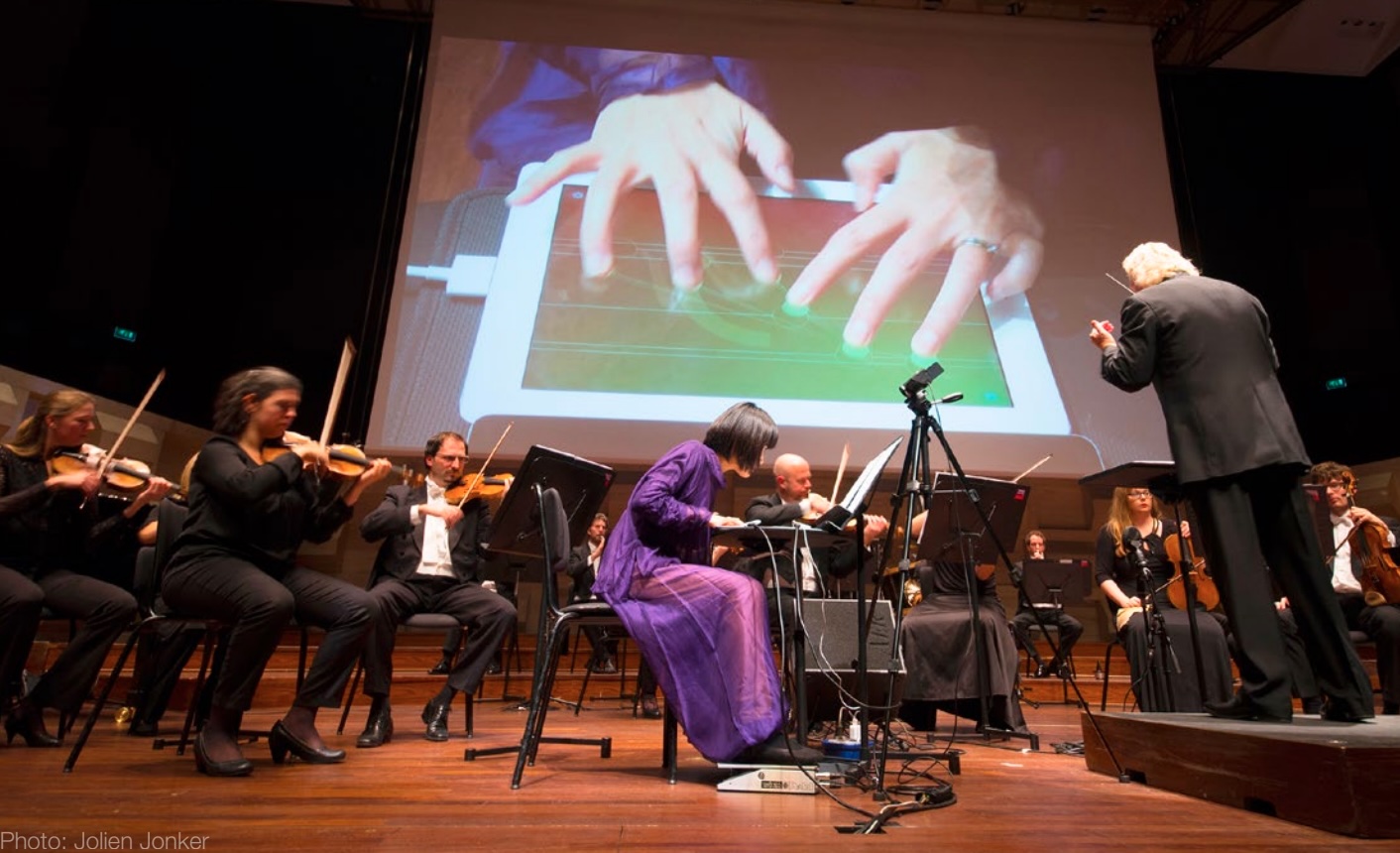
Concerto for iPad and orchestra
1-1-1-0
1 percussion
piano
strings (4-4-3-3-1 minimal)
solo iPadapps: Geo Synth, Bowls HD, TC-11, TapStereo, Monolith LOOP, MadPad, SampleWiz and Animoog.
View the brochure:
PREVIOUS PREFORMANCES:
March 8, 2016
Teatro Pedro Calmon, Setor Militar Urbano, Brasilia, Brazil
Claudio Cohen – conductorOctober 15, 2015
Performed by Sinfonia Rotterdam
Keiko Shichijo – iPad
Conrad van Alphen – conductorOctober 15, 2015
De Doelen, Rotterdam, the Netherlands
Performed by Sinfonia Rotterdam
Keiko Shichijo – iPad
Conrad van Alphen – conductorSeptember 14, 2013
Whitehead Auditorium, Valdosta, USA
Performed by Valdosta Symphony Orchestra
Keiko Shichijo – iPad
Howard Hsu – conductor
September 12, 2013
Whitehead Auditorium, Valdosta, USA
School concert
Performed by Valdosta Symphony Orchestra
Keiko Shichijo – iPad
Howard Hsu – conductor
October 19, 2012
Muziekgebouw aan ‘t IJ, Amsterdam, the Netherlands
Performed by Sinfonia Rotterdam
Susanna Borsch – iPad
Conrad van Alphen – conductor
October 18, 2012
De Doelen, Rotterdam, the Netherlands
Performed by Sinfonia Rotterdam
Susanna Borsch – iPad
Conrad van Alphen – conductor
October 16, 2012
De Wereld Draait Door, Dutch television
Susanna Borsch – iPad
Conrad van Alphen – conductorJune 1, 2012
De Doelen, Rotterdam, the Netherlands
Performed by Sinfonia Rotterdam
Keiko Shichijo – iPad
Conrad van Alphen – conductor
Five questions from De Doelen Rotterdam for composer Ned McGowan:
1. A concerto for orchestra and… iPad! What can we expect?
You can expect the soloist to play the iPad in front of the orchestra, just as if it was a piano or violin concerto. Also, at one point the screen of the iPad will be projected on a large screen behind the orchestra so that the audience can see what the soloist sees – ‘een kijkje in de keuken.’
2. Can you tell something about the possibilities of the iPad as an musical instrument?
This is where it gets interesting. Various people have designed apps (programs for the iPad) with new graphical interfaces where one can control sound through gestures on the touchscreen. Throughout the Concerto I use eight different apps, each of which has its own approach.
3. Is it possible to play the iPad part of the composition by yourself? Or do you really need a pianist to do this?
4. Can you define the style of your compositions? [I read something about a mix of styles for your new composition; jazz, rock, minimalism]
5. Did classical composers influence your new composition? And if so, which one(s)?
On October 15, 2015, Concerto for iPad & Orchestra was played again, by Sinfonia Rotterdam, with Keiko Shichijo (iPad) and Conrad van Alphen (conductor), in De Doelen. More info and updates about the concert can be found on the Facebook page: www.facebook.com/IPadConcerto/.
This is what the director of the Culture Fund had to say about it:
“A pleasantly surprising piece on so many levels: exciting, engaging, and magical. McGowan has created a symphony that makes the integration of the iPad seem so natural, so ‘of course’, that you wonder why it hasn’t been done before or more often.
The iPad, with literally in nite possibilties, proves to be a worthy addition to the spectrum of orchestral instruments, and Keiko Shichijo demonstrates magni cently how musicianship and expressiveness can be conveyed via this new instrument.
The projection of the instrument on a large screen con- tributes to the work’s accessibility – commonly lacking in contemporary music – and the int”egration of sounds with the traditional orchestral instruments results in a piece that is both pioneering and an instant classic.”